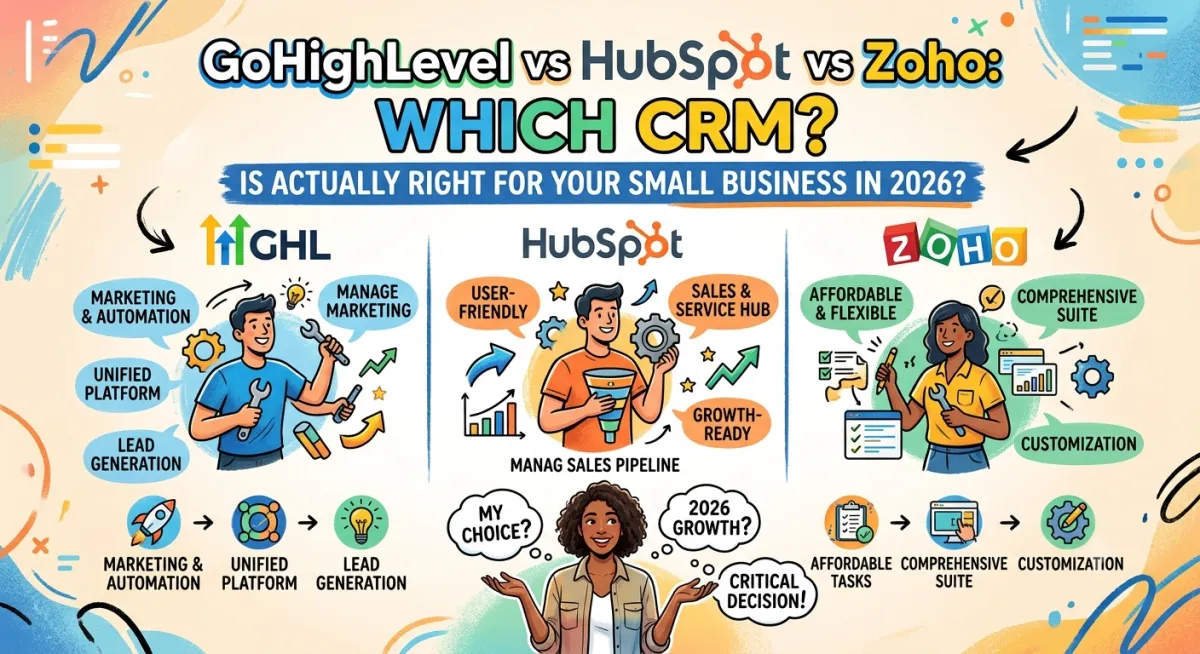
GoHighLevel vs HubSpot vs Zoho: Which CRM Is Actually Right for Your Small Business in 2026?
GoHighLevel vs HubSpot vs Zoho: Which CRM Is Actually Right for Your Small Business in 2026?
Let me start with something most CRM comparison articles will never say out loud.
Most small businesses that buy a CRM see almost no return from it.
Not because CRM does not work. Not because the platforms are bad. But because the wrong platform was chosen for the wrong reasons. Usually it comes down to a flashy free tier, a persuasive sales email, or a comparison article that ranked everything highly without committing to a real recommendation.
I have spent years building and managing CRM systems for US-based small businesses at Idievo INC.. I have configured GoHighLevel accounts from scratch, helped clients migrate off HubSpot when it became too expensive to justify, and watched Zoho deployments go both ways. I understand these platforms not from reading about them but from living inside them every day on behalf of real businesses trying to solve real problems.
This comparison exists because I kept having the same conversation. A business owner would come to us after spending three months and several hundred dollars on a CRM that was never going to work for them. Not because they made a stupid decision but because nobody gave them a straight answer before they signed up.
That is what this article is. A straight answer.
By the end of it, you will know exactly which CRM fits your business, what it will actually cost you, what to expect when you set it up, and what the platform will not do. The things these platforms cannot do are just as important as the things they can.
Before We Compare Anything, Let's Talk About What a CRM Actually Is
This might sound obvious but it is worth saying clearly because the definition of CRM has expanded dramatically in recent years. The three platforms we are comparing use the word to mean very different things.
At its core, a CRM or Customer Relationship Management system is a tool that centralizes information about your leads and clients, tracks where they are in your sales process, and helps your team follow up at the right time in the right way. That is the minimum. A basic CRM is essentially a smart organized contact database with a pipeline attached to it.
But modern CRM platforms have expanded well beyond that. Today when someone says CRM they might mean a contact database, a pipeline manager, an email marketing tool, an SMS platform, an automation engine, a website builder, a funnel tool, an appointment scheduler, a reporting dashboard, a client portal, and a dozen other things bundled into one subscription.
The question is not just which CRM is best. The question is which platform does the right things for your specific business at a price you can actually sustain.
GoHighLevel, HubSpot, and Zoho each answer that question differently. Here is how.
The Three Platforms: A Foundational Overview
GoHighLevel: Built for Agencies and Service Businesses That Want Everything in One Place
GoHighLevel, often shortened to GHL, was launched in 2018 with a specific audience in mind. It was designed for marketing agencies who needed a white-label platform they could use to manage clients and resell as their own product. Over the years it has evolved into something much broader but its core identity remains the same. It is an all-in-one platform designed to replace your entire marketing and CRM tech stack under one roof.
When you log into GoHighLevel you are not just getting a CRM. You are getting a CRM, an email marketing platform, an SMS tool, a funnel builder, a website builder, an appointment scheduler, a reputation management system, a social media planner, a course and membership builder, a client portal, a white-label product, and one of the most powerful automation workflow engines available to small businesses today.
Everything connects. A lead fills out a form on your website, gets added to your CRM pipeline, receives an automated SMS within 90 seconds, gets an email follow-up sequence, books an appointment through an embedded calendar, and triggers a task assignment for your team. All of that happens without a single manual action from you.
That is the GoHighLevel promise. And when the platform is set up properly, it actually delivers on it.
The catch is that phrase "set up properly." GoHighLevel is not a plug-and-play tool. It is a powerful platform that rewards businesses who invest time in configuration and punishes those who treat it like a self-service product. A poorly built GoHighLevel account is just as useless as no CRM at all. This is exactly why agencies like Idievo exist. We specialize in building these systems correctly from day one so you do not spend months learning through trial and error.
GoHighLevel is built for service-based businesses, agencies, consultants, coaches, local businesses, and any small business that wants their CRM, marketing, and automation all running from one system.
HubSpot: Built for Inbound Marketing and Businesses That Prioritize Content and Lead Generation
HubSpot is the most recognized name in CRM among small business owners and for good reason. It pioneered the concept of inbound marketing, the idea that you attract customers to you rather than chasing them, and built its entire platform around supporting that philosophy.
HubSpot offers a genuinely impressive free tier that includes contact management, a basic pipeline, email marketing, live chat, and a handful of automation features. For a business just starting out and trying to understand what a CRM can do for them, HubSpot's free plan is one of the most accessible entry points in the market.
The contact record in HubSpot is one of the best in the industry. It is clean, organized, and surfaces exactly the information your team needs without feeling cluttered. The reporting dashboard is powerful and the marketing tools, particularly the email builder and the SEO tools, are best in class.
But here is where HubSpot's story gets complicated for small businesses specifically.
HubSpot's free plan is genuinely useful but the moment you need real automation, proper sales sequencing, or meaningful reporting, you hit a wall. The features that make HubSpot actually powerful are locked behind paid tiers that are priced for mid-market companies, not small businesses watching their margins.
The Professional tier for HubSpot Marketing Hub starts at around $800 per month. The Sales Hub Professional is around $450 per month. If you want the full picture with marketing, sales, and service all properly automated, you are looking at well over $1,500 per month before you have added a single integration or extra seat.
For a small business generating under $500,000 per year in revenue, that is a very hard number to justify.
HubSpot is exceptional at what it does. But what it does best, including inbound marketing, content-driven lead generation, and enterprise-level reporting, is not always what small businesses need most.
HubSpot is built for B2B companies with an existing content strategy, businesses with a sales team that needs a clean CRM interface, and companies that are growing toward mid-market and need a platform that scales with them.
Zoho CRM: Built for Flexibility and Businesses That Want an Affordable, Customizable System
Zoho is the quieter and more affordable alternative that often gets overlooked in conversations dominated by HubSpot's marketing budget and GoHighLevel's agency momentum. That is a mistake because for the right business, Zoho is one of the most capable and cost-effective CRM platforms available.
Zoho CRM is part of the broader Zoho One ecosystem, a suite of over 40 business applications that includes accounting, HR, project management, email, and much more. If your business is already using or considering Zoho tools across multiple functions, the integration argument for Zoho CRM becomes extremely compelling.
The platform's core CRM functionality is solid. Pipeline management is clean and visual. Contact records are detailed. Lead scoring is built in. Workflow automation through Zoho's Blueprint feature is genuinely powerful once configured. And the pricing is among the most competitive in the market with paid plans starting around $14 to $20 per user per month.
Where Zoho struggles is in the areas that small businesses often care about most, which is ease of setup and the overall user experience. Zoho has a reputation for being complex to configure and less intuitive than either GoHighLevel or HubSpot. The interface, while functional, has not been a design priority and can feel dated compared to the cleaner more modern experiences offered by its competitors.
Zoho also lacks GoHighLevel's built-in marketing infrastructure. If you need SMS automation, funnel building, or website hosting alongside your CRM, you will need to either add separate Zoho apps or integrate third-party tools, which adds cost and complexity.
Zoho is built for small businesses that need a capable affordable CRM without the premium pricing of HubSpot, businesses already embedded in the Zoho ecosystem, and companies with technical resources who can handle a steeper setup curve.
Feature-by-Feature Comparison
Now let us get into the details that actually matter.
CRM and Pipeline Management
GoHighLevel
GoHighLevel's pipeline management is built for service businesses that handle leads across multiple stages. You can create multiple pipelines, customize every stage, and set up automation triggers that fire when a deal moves from one stage to another.
The Smart Lists feature is genuinely excellent. It lets you create dynamic contact lists based on tags, pipeline stage, engagement behavior, or any combination of custom fields. This means your team always has a clean segmented view of exactly who needs attention and when.
The contact record in GoHighLevel is comprehensive. You can see all conversations including email, SMS, Facebook Messenger, Instagram DMs, and phone calls in a single unified inbox. For a service business communicating with clients across multiple channels, this is a significant operational advantage.
At Idievo, when we handle CRM setup and management for clients, GoHighLevel's pipeline system is almost always where the biggest operational improvements happen. The ability to automate what happens when a lead moves from one stage to another eliminates the follow-up tasks that fall through the cracks in every manual system.
The weakness is the interface. GoHighLevel's contact record is information-dense, which is useful once you know your way around but overwhelming for first-time users. New team members typically need onboarding support to get comfortable with the system.
HubSpot
HubSpot's pipeline and contact management is the cleanest of the three. The drag-and-drop pipeline view is intuitive, the contact records are beautifully organized, and the activity timeline showing every email, call, meeting, and note associated with a contact is one of the best in the market.
For sales teams that live inside the CRM, HubSpot's interface is genuinely superior to GoHighLevel's. The user experience is polished, the mobile app is excellent, and the learning curve for new team members is significantly lower.
However, HubSpot's pipeline automation is limited on lower tiers. Moving a deal between stages does not automatically trigger follow-up sequences, assign tasks, or fire SMS messages unless you are on a paid tier. The automation you expect to be built in requires a subscription upgrade that many small businesses find difficult to justify.
Zoho
Zoho's pipeline management is capable and visual, with Kanban-style deal tracking, multiple pipeline support, and solid filtering options. The Blueprint feature, which enforces a structured sales process by requiring specific actions before a deal can advance to the next stage, is a standout that neither GoHighLevel nor HubSpot replicates as well.
For businesses with a defined repeatable sales process that requires compliance or quality control, such as real estate agencies, legal firms, or healthcare practices, Blueprint is genuinely powerful.
The weakness is the same as Zoho's general weakness. The interface is dated and the setup complexity is higher than either competitor.
Overall winner for most small businesses is GoHighLevel because the automation tied to the pipeline is where the real operational value lives.
Marketing Automation
This is the most important category for most small businesses and the one where the differences between these platforms are most dramatic.
GoHighLevel
GoHighLevel's workflow automation engine is the single most powerful feature of the platform. You can build automation sequences that span SMS, email, voicemail drops, phone calls, Facebook Messenger, Instagram DMs, Google My Business messages, and internal notifications. All of this can be triggered by a single form submission, a pipeline stage change, a tag, an appointment booking, a missed call, or dozens of other events.
The visual workflow builder supports conditional logic, meaning your automations can branch based on contact behavior. Did the lead open the email? Send them a follow-up. Did they not open it? Send an SMS instead. Did they book an appointment? Move them to a different pipeline stage and assign a task to your team.
There is no artificial ceiling on what you can automate in GoHighLevel. The platform does not lock advanced automation behind a higher pricing tier. Every workflow feature is available from the base plan.
This is arguably the biggest competitive advantage GoHighLevel has over every other CRM in this comparison. For a small business trying to automate their lead response, follow-up, appointment management, and client communication, GoHighLevel delivers more for less than any comparable platform.
At Idievo, our marketing automation work is almost entirely built on GoHighLevel's workflow engine. The results we see for clients, including faster lead response times, higher appointment booking rates, and more consistent follow-up, come directly from the automation capabilities that GoHighLevel makes available from its most affordable plan.
HubSpot
HubSpot's automation, called Workflows, is excellent but locked behind paid tiers. On the free plan you get basic email sequences and limited automation triggers. On the Starter plan automation is still restricted. On the Professional plan the full workflow engine opens up but that plan starts at $800 per month for Marketing Hub alone.
When you do have access to HubSpot's full automation suite it is powerful and well designed. The visual workflow builder is clean, the trigger options are comprehensive, and the integration with HubSpot's CRM data is seamless.
But the price-to-automation ratio is unfavorable for small businesses. You are paying significantly more for automation capability that GoHighLevel includes from its base plan.
Zoho
Zoho's automation through Workflows and Macros covers the basics well. You can automate email responses, field updates, task assignments, and basic follow-up sequences. The Blueprint feature adds process-based automation on top of this.
However Zoho lacks native SMS automation, does not have a built-in funnel builder, and its workflow logic is less sophisticated than GoHighLevel's. To get comparable automation depth to GoHighLevel you would need to add multiple Zoho apps and potentially integrate third-party tools, which adds cost and technical complexity.
Winner for marketing automation is GoHighLevel and it is not close. For a small business that wants real marketing automation without a $1,000 or more per month budget, GoHighLevel is the clear choice.
Pricing: The Full Picture
This is where most comparison articles mislead you because they compare starting prices without showing you what those starting prices actually include.
GoHighLevel Pricing
GoHighLevel offers three main plans.
The Starter plan at $97 per month includes one account, full CRM, pipeline management, email marketing, SMS automation, funnel and website builder, calendar booking, reputation management, social media planner, workflow automation, and the unified conversation inbox. This is a comprehensive feature set at a price that is accessible for most small businesses.
The Unlimited plan at $297 per month removes all account limits, adds API access, and unlocks the SaaS mode for white-label reselling. If you are an agency managing multiple clients or want to resell GHL as your own product, this is the plan to be on.
The SaaS Pro plan at $497 per month adds advanced SaaS features including automated sub-account creation and custom pricing models for reselling.
For a typical small business, the $97 Starter plan covers everything they need. For agencies managing clients, the $297 Unlimited plan is the entry point.
Additional costs to factor in include SMS and email sending costs charged per message through its LC Phone and LC Email systems, plus the cost of additional phone numbers. These are usage-based charges that vary by volume but a typical small business can expect to pay an additional $10 to $30 per month for communications depending on usage.
All in, most small businesses run their entire GoHighLevel operation for $100 to $130 per month.
HubSpot Pricing
HubSpot's pricing structure is more complex and scales significantly with usage.
The free plan includes contact management, a basic pipeline, email marketing with HubSpot branding, forms, live chat, and limited automation. It is genuinely useful for getting started but the limitations become apparent quickly.
The Starter plan for Marketing Hub begins at approximately $20 per month for 1,000 contacts. This removes HubSpot branding and adds slightly more automation but the workflow capabilities are still limited.
The Professional plan for Marketing Hub starts at approximately $800 per month for 2,000 contacts. This unlocks the full automation suite, A/B testing, dynamic content, and advanced reporting. If you also need the Sales Hub Professional at around $450 per month and the Service Hub Starter at around $15 per user per month, you are looking at well over $1,200 per month for a full CRM and marketing operation.
For a small business, HubSpot's free plan is a reasonable starting point if budget is the primary constraint. But the moment you need real automation you are facing a significant pricing jump that most small businesses cannot sustain.
Zoho CRM Pricing
Zoho's pricing is the most affordable of the three platforms.
The free plan supports up to three users and includes basic CRM features, contact and deal management, and limited automation.
The Standard plan starts at approximately $14 per user per month and adds email integration, workflow rules, scoring rules, and basic analytics.
The Professional plan at approximately $23 per user per month adds Blueprint, inventory management, and enhanced automation.
The Enterprise plan at approximately $40 per user per month unlocks advanced AI features through Zoho's Zia AI, advanced customization, and multi-user portals.
If you are a team of three and do not need SMS automation or advanced marketing features, Zoho's Professional plan at around $70 per month total is a very affordable option. The catch is that adding Zoho's other tools like Zoho Campaigns for email marketing or Zoho SalesIQ for live chat adds cost quickly, and you may find yourself paying more than GoHighLevel's base plan for a less integrated system.
Pricing Summary
Platform Entry Point Full Features GoHighLevel $97 per month $97 to $297 per month HubSpot Free $800 to $1,500 or more per month Zoho CRM $14 per user per month $40 or more per user per month plus add-ons
For most small businesses, GoHighLevel delivers the most features for the most affordable all-in price.
Ease of Setup and Learning Curve
GoHighLevel
GoHighLevel has the steepest initial learning curve of the three platforms. The interface is dense, the feature set is vast, and the correct configuration of automations, pipelines, and communication channels requires real time and technical attention.
This is why most businesses who try to set up GoHighLevel on their own either take far longer than expected or end up with a system that is technically running but not actually optimized. The platform is powerful but that power requires someone who knows what they are doing to unlock it properly.
This is also why working with a specialized GoHighLevel agency makes a significant difference. At Idievo, our CRM setup and management service exists specifically to eliminate the trial-and-error period that costs most businesses weeks of wasted time. We have built enough GoHighLevel systems to know what works from day one, and we configure every client account with that experience behind it.
You can also see real examples of what properly built systems look like in our work section, where we document the outcomes of our client engagements.
The good news is that once GoHighLevel is properly set up, it runs largely on autopilot. The upfront investment in configuration pays back consistently over time. A properly built GoHighLevel account requires almost no daily manual work from you because the system handles the follow-up, the scheduling, the reminders, and the communications automatically.
HubSpot
HubSpot has the most polished onboarding experience of the three. The interface is clean and intuitive, the documentation is excellent, and the free tier allows you to start using the platform immediately without configuration complexity.
For a business that wants to self-serve their CRM setup without outside help, HubSpot is the most accessible starting point. This is a genuine advantage, particularly for businesses that do not have a technical person on their team.
The complexity in HubSpot tends to emerge later, when you are trying to build advanced automation sequences, manage large contact databases, or integrate the platform deeply with your sales process. At that point the learning curve steepens and professional help becomes valuable.
Zoho
Zoho is widely acknowledged to have the steepest learning curve of the three platforms. The interface is less intuitive, the documentation is less accessible, and the sheer number of configuration options can be overwhelming without guidance.
For businesses without a technically capable team member or outside CRM support, Zoho's setup complexity is a real barrier. The platform rewards those who invest in proper configuration but getting to that point requires more patience than most small business owners are prepared for.
Winner for ease of initial setup is HubSpot. Winner for long-term payoff once properly configured is GoHighLevel. Zoho requires the most effort with the least intuitive experience.
Integration and Ecosystem
GoHighLevel
GoHighLevel integrates natively with Stripe for payments, Facebook and Google for ad management and lead capture, Google My Business, QuickBooks, and a growing list of third-party tools through Zapier and its native API.
The platform's own ecosystem is broad enough that most small businesses never need an external integration. The built-in tools cover the vast majority of what a service business needs to operate. For more specialized integrations, Make and Zapier handle the connection reliably.
HubSpot
HubSpot has one of the largest integration ecosystems in the CRM space with over 1,000 native integrations across sales, marketing, service, and operations tools. If your business relies on a specific third-party tool, the probability that HubSpot has a native integration for it is extremely high.
This is a genuine competitive advantage for businesses with complex multi-tool environments. For most small businesses running a straightforward service operation, the integration depth of HubSpot's ecosystem is more than they will ever need.
Zoho
Zoho's integration story is strongest within its own ecosystem. The 40 or more Zoho applications connect natively and share data seamlessly, making the full Zoho One suite a compelling option for businesses that want to run their entire operation on one vendor.
Outside of the Zoho ecosystem, native integrations exist for common tools but are not as extensive as HubSpot's marketplace.
Winner for raw integration breadth is HubSpot. Winner for self-contained functionality that reduces the need for integrations in the first place is GoHighLevel.
Reporting and Analytics
GoHighLevel
GoHighLevel's reporting has improved significantly over the past two years but remains the weakest area of the platform compared to HubSpot. Pipeline reporting, source attribution, appointment metrics, and campaign performance are all covered. The dashboard is customizable and the data is useful for understanding how your business is performing.
Where GoHighLevel falls short is in advanced analytics and cross-campaign attribution. For a small business tracking lead volume, conversion rates, and revenue by source, GoHighLevel's reporting is more than adequate. For a marketing team trying to attribute revenue across complex multi-touch campaigns, it shows its limitations.
HubSpot
HubSpot's reporting is genuinely best in class. The custom report builder on paid tiers allows you to create virtually any view of your data. Revenue attribution, funnel analysis, email performance, sales activity, and customer lifecycle reporting are all deeply developed and visually polished.
If data-driven decision making is central to how your business operates, HubSpot's reporting capabilities are a meaningful differentiator.
Zoho
Zoho's analytics, particularly through Zoho Analytics which integrates with Zoho CRM, are powerful and highly customizable. The standalone Zoho Analytics tool is one of the better business intelligence platforms available for small businesses and its integration with the CRM makes cross-functional reporting accessible.
For businesses that take reporting seriously and need analytics depth that goes beyond basic CRM dashboards, the Zoho and Zoho Analytics combination is worth considering.
Winner for reporting depth is HubSpot. Zoho Analytics is a strong alternative. GoHighLevel is adequate for most small business reporting needs but is not the platform to choose if analytics is your primary priority.
AI Features in 2026
All three platforms have invested significantly in AI capabilities over the past two years.
GoHighLevel
GoHighLevel launched its AI Employee suite in late 2025, which includes Voice AI for handling inbound phone calls, Conversation AI for managing live chat and SMS conversations, and Workflow AI for suggesting automation improvements. The Voice AI feature is particularly significant for service businesses. It allows a business to have an AI receptionist that answers calls, qualifies leads, books appointments, and logs everything in the CRM automatically.
The AI features are available as add-ons with usage-based pricing. They are not perfect but for a small business that receives inbound calls and struggles with response time, the capability is real and valuable.
HubSpot
HubSpot's AI capabilities are woven throughout the platform. AI-assisted email writing, predictive lead scoring, content recommendations, SEO suggestions, and ChatSpot, an AI assistant for querying your CRM data in natural language, are all available on paid tiers.
HubSpot's AI is generally more polished than GoHighLevel's at this stage. The integration of AI into the content and marketing tools is particularly strong, making HubSpot an excellent choice for businesses that produce a lot of content and want AI assistance built into their marketing workflow.
Zoho
Zoho's AI is called Zia and it covers lead scoring, sales predictions, anomaly detection, and natural language queries of CRM data. Zia has been part of Zoho since 2017, making it one of the more established AI features in the CRM market, and the capabilities have matured meaningfully in recent years.
For businesses on the Zoho Enterprise plan, Zia's predictive analytics and automated suggestions are genuinely useful for prioritizing sales activity and identifying at-risk deals before they stall.
Winner for polish and integration across the platform is HubSpot. Winner for practical AI features that directly impact service business operations is GoHighLevel. Zoho wins for established predictive analytics.
Head-to-Head: The Real-World Scenarios
Let me take this out of the feature chart and into the real world. Here are the scenarios I see most often and which platform wins each one.
Scenario 1: A local service business such as HVAC, cleaning, landscaping, or plumbing
You run a local service business. You get leads from Google, Facebook, and referrals. You need to respond fast, book appointments, send reminders, collect reviews, and re-engage clients who have not booked in a while.
Winner is GoHighLevel, decisively.
The combination of instant lead response automation, appointment scheduling, review request workflows, and the missed call text-back feature makes GoHighLevel the most purpose-built platform for this use case. HubSpot's free plan covers the basics but lacks the SMS automation and appointment-specific workflows. Zoho requires additional tools and setup complexity for the same outcome.
If you are in this situation and want to see what we build for businesses like yours, you can review some of the work we have done for similar clients at idievo.com/work.
Scenario 2: A B2B company with a sales team and a content marketing strategy
You run a B2B service company. You have two to three salespeople. You produce blog content, run webinars, and generate leads through inbound channels. Your sales cycle is 30 to 90 days and involves multiple touchpoints before a deal closes.
Winner is HubSpot for this specific use case.
HubSpot's inbound marketing tools, content management, email sequencing, and deal management are built exactly for this scenario. The Professional tier pricing is painful but if content-driven B2B lead generation is your primary growth engine, HubSpot's tools justify the investment better than GoHighLevel's.
Scenario 3: A small business on a tight budget that needs basic CRM and pipeline management
You are a solo founder or small team. You need to track your leads, manage your pipeline, and send some follow-up emails. You do not need advanced automation and you cannot justify $100 per month right now.
Winner is Zoho or HubSpot's free tier.
Both offer genuine CRM functionality for free or near-free. Zoho's free plan supports up to three users and is more functional than most people expect. HubSpot's free plan has a cleaner interface and a better onboarding experience. For a business at this stage, either is a reasonable starting point with the expectation that you will outgrow it.
Scenario 4: A marketing agency or consultant managing multiple clients
You run an agency. You want one platform to manage your own operations and your clients' CRM and marketing systems. You want to offer CRM as a service and build recurring revenue.
Winner is GoHighLevel without question.
The white-label capability, sub-account architecture, snapshot system, and SaaS reseller mode make GoHighLevel the only platform in this comparison that was actually designed for this use case. Neither HubSpot nor Zoho offers anything comparable for agency operations at this price point.
If you are an agency exploring what white-label CRM looks like as a product you can sell, we cover this in detail through our services page. We also run an affiliate program for agencies and consultants who want to refer clients to Idievo and earn recurring commissions.
Scenario 5: A coach, consultant, or online business selling courses and memberships
You sell knowledge and expertise. You need a landing page, a funnel, a checkout process, a course platform, and a CRM to manage your leads and clients.
Winner is GoHighLevel.
The built-in funnel builder, membership and course hosting, calendar booking, and payment processing through Stripe make GoHighLevel a genuine alternative to ClickFunnels, Kajabi, and multiple other tools combined. For a solopreneur or small team trying to consolidate their tech stack, GoHighLevel replaces tools that would otherwise cost $300 to $500 per month in separate subscriptions.
The Honest Verdict
Here is the recommendation I give to the majority of small businesses I work with, stated as plainly as possible.
If you are a service-based small business in the United States, GoHighLevel is the right choice for most of you.
The combination of full CRM, SMS and email automation, funnel and website building, appointment scheduling, reputation management, and white-label capability at $97 per month is genuinely unmatched. No other platform in this comparison and very few platforms in the broader market give you this much operational capability for this price.
The caveat is setup. GoHighLevel is not a self-serve platform. It requires proper configuration to deliver on its promise and that configuration is best done by someone who has done it before. A poorly configured GoHighLevel account is just as ineffective as no CRM at all. But a properly built one runs your business in the background with almost no manual intervention, and that is exactly what a small business with a lean team needs.
Choose HubSpot if you are a B2B company with a content marketing strategy and a sales team that needs a polished easy-to-use interface. You need the budget for the Professional tier and your growth depends on inbound lead generation more than operational automation.
Choose Zoho if you are on a tight budget, you are already embedded in the Zoho ecosystem, or you need a capable CRM that your team can use without significant onboarding. Be prepared for a steeper setup curve and plan to supplement with additional tools for marketing automation.
Choose GoHighLevel if you are a service business, agency, consultant, coach, or local business that needs CRM, automation, marketing, and client communication all in one place at a price that makes sense for a small business. Or if you want to offer CRM as a service to your own clients.
What to Do Before You Choose Any CRM
Before you sign up for any of these platforms, do these three things first.
Map your current process on paper. Write down what happens when a lead contacts you today, from the moment they fill out a form or send a message to the moment they become a paying client. Where do leads fall through the cracks? Where does your team spend the most manual time? The answers to those questions should drive your platform choice, not features you think you might need someday.
Be honest about your setup capacity. Do you have someone on your team who can configure a CRM properly? Do you have the time to do it yourself? Or do you need outside help? The most important CRM is the one that actually gets used, not the most feature-rich one that nobody configures correctly.
Think about where you want to be in 12 months, not where you are now. The right CRM for your current situation might not be the right CRM for your business a year from now. GoHighLevel scales from a one-person operation to a full agency. HubSpot scales from free to enterprise. Zoho scales across an entire business operating system. Choose the platform that grows with the direction you are heading.
How Idievo Can Help
At Idievo INC., we specialize in building and managing GoHighLevel CRM systems for US small businesses. We design the pipeline, configure the automations, connect your communication channels, and hand you a system that is ready to work from day one.
Our full range of services covers CRM setup and management, marketing automation, website development, and social media management. Every service is built around the same principle: your business should run more smoothly after working with us than before.
If you have read this far and you are thinking GoHighLevel might be the right fit for your business but you do not want to spend months figuring out the configuration on your own, that is exactly where we come in.
We offer a free CRM audit where we review your current setup, identify where you are losing leads and revenue, and recommend the right system for where your business is going. You can request your free audit through our contact page.
If you are earlier in the decision-making process and want to explore what a properly built CRM system looks like before committing, book a free strategy call and we will walk you through it with no obligation on your end.
If you run into any questions during your CRM research, you can also reach our team through the Idievo Support Center or access the client portal if you are already working with us.
Building the right CRM system is one of the most impactful things you can do for your business this year. Not because of the software but because of the operational clarity, the automatic follow-up, and the revenue you stop leaving on the table when every lead is tracked, nurtured, and followed up without anyone having to remember to do it.
That is what a properly built CRM does. And that is what we build.